
This morning, Westpac Banking Corporation (WBC) provided a third-quarter update, which was around expectations but came with a weaker outlook for loan growth. We usually don’t comment on trading updates as they are too volatile and can give a misleading picture, both positive and negative, but today’s share price move warrants a brief note. The HNW Core Portfolio holds a 7% weight to WBC.
Key Points:
- Mortgage Portfolio: Net profit increased by 2% to $1.8 billion for the quarter, driven by a higher net interest margin and cost management, which saw expenses increase by only 1% for the year, well below the current inflation rate. WBC also saw an increase of 7% in loans to $908 billion, and deposits also increased by 7% to $759 billion. Net interest margin steady at 1.89%
- Low Bad Debts: Bad debts are nowhere to be seen in Westpac’s results, with a mere 0.1% of loans currently being impaired. Atlas continues to believe that the “riskier” loans now sit with private credit funds rather than the banks, which have to hold capital against the loans.
- Capital Ratio: WBC’s capital ratio, at 12%, remains at the top of the bank’s target operating range, even after paying out the first half dividend. A prudent move given the current macroeconomic environment. Westpac will be resuming its on-market share buy-back over the next few months, applying $1B from the sale of RAMS.
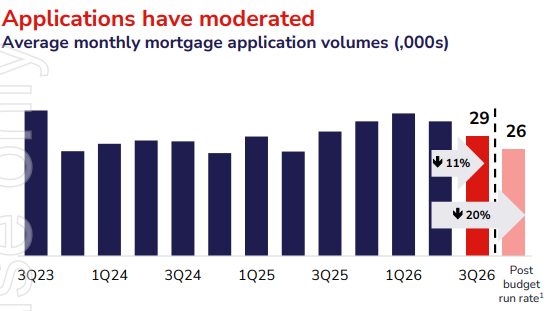
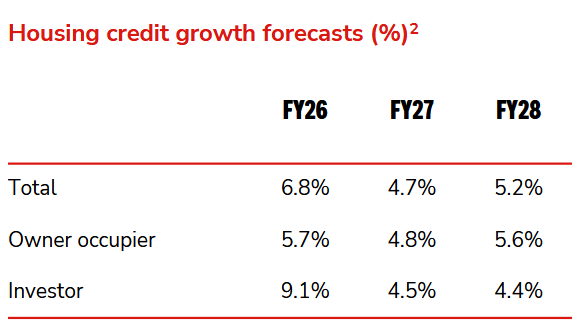
- Why is the stock down? The stock is down due to the outlook for mortgage growth, with mortgage applications down 20% post the budget tax changes and expectations of higher rates to an average of 29,000 applications a month (See Below). Most of the fall in applications is, not surprisingly, coming from real estate investors rather than owner-occupier applicants due to changes to negative gearing in the 2027 Budget. This was not a surprise and we expected moderating
CEP Strategy: This was a solid result from Westpac, with the business travelling well. We own WBC in the Portfolio due to its heavy exposure to mortgages, which comprise 65% of WBC’s loan book. Through the cycle, mortgages have historically had lower bad debt charges than business lending due to Australia’s home loan recourse lending and higher margins. While we expect loan losses to increase, higher net interest margins will offset this. We remain happy holders of the bank, which trades on a PE of 17x with a 4.5% (grossed up 5.7%) fully franked yield. Controlling costs was a highlight in the current inflationary environment. We see today’s share price reaction as excessive; Westpac remains a very solid and profitable bank, and the resumption of the buy-back should support the share price.
The major banks have a very good long-term record of growing profits despite periodic regulatory and political challenges.
WBC finished down -5.9% to $35.70.